Ecommerce SEO: What You Need to Know
Ecommerce Stores Require a Tailored Approach.
What is Ecommerce SEO?
Ecommerce SEO is search engine optimization specifically designed for online stores.
While traditional SEO often focuses on the factors such as search volume, ecommerce SEO prioritizes purchase intent. The goal is to optimize the home page, category, product and content pages to maximize ecommerce performance.
Ecommerce SEO is crucial for online businesses because organic traffic often has high conversion rate. Many customers begin their shopping journey with a Google search. If your store does not rank on the first page of search results for relevant keywords, you may be losing potential customers to your competitors.
Ecommerce SEO has various dimensions.
Optimizing an ecommerce website involves multiple factors such as keyword research, on-page SEO, technical SEO, link building, and performance on the search results page. For this reason, you need to adopt a holistic approach.
How is Ecommerce SEO Different from Traditional SEO?
While general basic SEO principles apply to all websites, some tactics in traditional SEO may not fit the needs of online stores. Ecommerce businesses should develop and implement tailored strategies to achieve success.
01
Transactional Intent
The main difference is prioritizing the transactional intent.
You should not focus only on search volume in ecommerce SEO. Even if you achieve success for irrelevant keywords and increase the visibility in search engines, it would not mean much if this traffic does not convert and has high bounce rate.
What is worse, this low-quality traffic will deteriorate the performance of your remarketing campaigns. The goal of ecommerce SEO should be to reach potential customers and drive traffic that is likely to convert.
02
Keyword Strategy
Ecommerce businesses should not optimize for informational queries simply because they have high search volume. Keyword strategy should focus on conversion perspective, prioritizing intent over volume.
Adapting smart strategies can be the key to maximize performance. For example, all ecommerce stores focus on keywords related to their business. You can create competitive edge by focusing also on keywords related to customer shopping journey or target audiences.
03
Handling Category, Product, and Content Page Types Separately
Different from traditional SEO which often focuses on a single page type and content, ecommerce SEO deals with different page types separately.
You should develop effective strategies for category, product, and content pages, complementing each other and creating synergy as a whole.
04
Handling High Number of Pages and Duplicate Content
Ecommerce websites often have high number of pages. Many of these pages are generated automatically by features such as faceted navigation, creating thousands of similar pages with duplicate content.
Since this consumes the crawl budget inefficiently and high number of low-quality pages having duplicate content can harm your SEO efforts, these pages should be handled carefully. You should use canonical structure effectively to maximize the performance of your store.
What Are the Benefits of Ecommerce SEO?

Ecommerce SEO provides significant benefits for online stores.
Increases Organic Traffic
Ecommerce stores need visitors to generate sales and grow their businesses. Once implemented successfully, ecommerce SEO generates a flow of visitors to your website. This will be high-quality traffic, including people who search for terms relevant to your products.
Reduces Dependence on Paid Ads
Ecommerce businesses need to allocate considerable budgets to advertising campaigns to generate results. They lose all the traffic if the budget runs out. When they achieve success with ecommerce SEO, they can lower the budget or allocate the budget elsewhere.
Long-Term ROI
Organic search traffic does not have a direct cost per click. Once ecommerce stores achieve success, this serves as an effective and sustainable way to drive traffic and revenue. Unlike paid ads, ecommerce SEO still drives visitors and deliver results, even when you lower your efforts. It can be a sustainable revenue-generating channel. SEO results may compound over time. This means that when you keep working on your project, you may observe an incremental increase in your results.
Reduce Customer Acquisition Costs
Organic traffic is often among the top channels driving traffic and conversion. Ecommerce SEO helps you to reach the users who are searching for specific products and have a higher intent to buy. As it can deliver results for a long period of time with acceptable costs, it lowers the customer acquisition costs for ecommerce stores.
Improves Brand Authority
When your website appears at the top of search results for relevant keywords, it has the potential to enhance trust and credibility among customers.
How Long Does Ecommerce SEO Take?
Ecommerce SEO projects can provide different results for different ecommerce stores. The results depend on various factors such as the search competition in your segment, your website structure, or how well optimized competitor websites are.
Given this, you can expect the following results in the short or medium term.
Short-Term Ecommerce SEO (1-6 Months)
An SEO project usually starts with an SEO audit that reveals potential issues and areas to grow. After this, you need to prepare a plan that includes strategies, actions, and potential results. Keyword research is an important part of the process as it helps ecommerce stores to reach the people that are more likely to convert.
You should optimize on-page SEO factors, giving priority to content strategy and linking structure. Different page types such as category, product, and content pages should be handled separately. Regarding technical SEO factors, you may give priority to factors such as site speed and mobile usability. Handling structured data is crucial at this stage as it also impacts AI backed searches significantly. Link building is also crucial to increase your authority. You should try to increase your popularity at least in your niche to convince the search engines that you are a credible source.
Medium-Term SEO (6-12 Months)
At the initial stage, you complete your SEO audit, develop a project plan and formulate your strategy. You begin to optimize your pages, improve technical SEO, and work on increasing your popularity. This forms a strong foundation for your store.
After this period, it is time to monitor your progress and assess growth opportunities. You should analyze the performance of your current pages and make revisions when necessary to improve the results. You can create new pages to cover the keywords that cannot be targeted by existing pages. This can help you to reach and communicate with niche segments effectively and enjoy low competition. This tailored approach often leads to good conversion rates. Enhancing on-page and technical SEO factors, building high-quality backlinks from reputable sites related to your niche, and generating high social engagement can also help your ecommerce store to improve results in this period.
AI SEO (GEO) for ECOMMERCE
SEO has always been evolving, but the pace of change has accelerated, especially in recent years.
The rise of AI platforms has profoundly impacted search behavior and SEO. Traditional search engines function based on their algorithms and rank pages based on various factors such as keyword relevance, backlinks, and page experience.
AI search brings a whole new perspective. It prioritizes delivering direct answers to queries, often without the need to click on any links. This reduces the need to visit websites to find information.
While AI and traditional SEO share the main principles, they may require different approaches.
Since AI platforms may use Bing results as a base for its results, the importance of Bing SEO has increased recently. Since AI platforms incorporate a high number of elements when providing a response, achieving a good reputation and popularity in your niche became crucial to be featured for relevant queries. Prioritizing context, adopting a conversational tone, and using schema markup effectively also gained importance.
Since this topic is crucial for online businesses I cover it in a separate section in my Ecommerce SEO book and The Ecommerce Growth System.
Ecommerce SEO Book
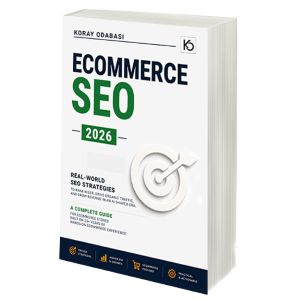
This is a complete and up-to-date resource for ecommerce stores. This book combines proven ecommerce SEO tactics, practical frameworks, real-world examples, and solutions to the most common issues. It is designed to help you prioritize what matters, avoid costly mistakes, and maximize long-term organic growth.
Ecommerce SEO is a Part of The Ecommerce Growth System
The Ecommerce Growth System is a continuously updated resource built on real ecommerce execution across SEO, Google Ads and Meta Ads. Insights you can apply directly to your business.