Meta Ads for Ecommerce
A Fast and Effective Solution for Ecommerce Stores
Why Is Meta Ads Crucial for Ecommerce Stores?
Meta Ads is one of the most effective digital advertising platforms for ecommerce stores.
Billions of users visit Meta properties such as Instagram and Facebook, offering a great opportunity for ecommerce stores to reach potential customers on these platforms.
This can help online businesses to complement Google Ads campaigns and maximize cross-channel results. Targeting warm audiences on Meta platforms extends your reach and strengthens your message. It reinforces a strong brand perception.
As the AI revolution puts pressure on SEO and Google Ads search campaigns, increasing the size of owned audiences gains importance. Meta Ads offers a good alternative to communicate with your target audience and achieve conversion.
Since Meta Ads usually has relatively lower cost compared to other paid channels, it allows ecommerce stores to scale visibility even with limited budgets.
You can increase the size of your warm audiences by including the people who engaged with your Meta assets. As you already got their interest with your posts, it may be easier to achieve conversion on your website.
Meta offers detailed targeting options, allowing you to specify demographics, interests, and behaviors in detail. Using multi-layered targeting is a good way to refine audiences and identify niche target segments.
You can also benefit from Meta AI. As Advantage+ Shopping campaigns target the people who are most likely to buy, they usually generate high conversions. These campaigns prioritize showcasing the products that people browsed on your website or added to their shopping carts.
Based on your goals, Meta Ads can help your business to build awareness, generate traffic, or achieve sales.
How Can Ecommerce Stores Benefit from Different Campaign Types?
Generic Meta Ads tactics may generate poor results for online businesses. Ecommerce stores need tailored strategies to maximize their performance.
01
Sales Campaigns
Sales campaigns are the backbone of Meta Ads performance for ecommerce stores.
When you create a sales campaign, the Meta algorithm targets the users who are more inclined to buy and this is what an ecommerce store wants.
While the Meta algorithm often generates good results in automated sales campaigns, you should also run sales conversion campaigns. In these campaigns, you can test the performance of selected niche segments and fully benefit from warm audiences. This can help you maximize your conversions.
02
Traffic Campaigns
While achieving sales is the priority for ecommerce stores, they need to attract more visitors to their stores to grow their audiences and support sales.
Since sales campaigns (having purchase goal) focus on the people who are more likely to generate conversions, they often have high CPC rates. This means that, while they can generate high ROAS, they may not provide a high number of visitors.
Traffic campaigns can help online stores to drive high-quality traffic.
03
Awareness and Engagement Campaigns
While awareness campaigns are not the priority for ecommerce stores, they can be beneficial in certain cases.
Increasing the brand recognition in their niche can help improve their results. This is especially important for small or newly established ecommerce stores.
Engagement campaigns can be beneficial to communicate with the target audiences on a daily basis.
How Can Meta Ads Boost Ecommerce Results?

Meta Ads offers effective options to increase sales revenue. Sales campaigns are designed to generate conversions on your ecommerce store. You can benefit from Meta AI in automated campaigns such as Advantage+ campaigns. The Meta algorithm will optimize ad delivery based on user behavior and prioritize showcasing products that users browsed on your website or added to their shopping carts.
Meta Ads campaigns can also be beneficial to drive high-quality traffic. The key to success is to target the right people and communicate tailored messages. You should use advanced targeting options effectively to identify your target segments. Once these people browse your products, you can retarget them with sales campaigns to drive conversions.
Retargeting campaigns often deliver the highest return on ad spend (ROAS). By being persistent and communicating with the people who showed interest in your products, you can recover some of the lost sales opportunities.
You can use your marketing visuals to announce your campaigns or your catalog to showcase your products.
It can be helpful to allocate a small budget to awareness campaigns to improve brand recognition in your niche. This will also support your ecommerce performance in the long term.
How to Optimize Meta Ads for Ecommerce?
Some advertisers complain that Meta Ads fail to generate conversions. The key to success is to optimize the campaigns effectively.
This starts with your targeting. You should target warm and cold audiences separately. You should identify multiple niche segments and test their performances to understand which segments convert better. You can benefit from multi-layer targeting to reach high-value buyers and users that are more likely to convert.
Optimizing ad copy is also important. You should test the performance of different ad content and visuals. While strong marketing visuals may help you to communicate your message, using your product catalog may be more effective in generating conversions. It is a good idea to create product sets and highlight relevant products when you communicate with niche segments.
You should test the performance of automated targeting options and compare them to your other campaigns.
Improving your landing pages can also be considered as part of the optimization process. Your campaigns can perform well but your overall conversion will depend on the conversion on your website. For this reason, you should ensure that your pages are well-optimized.
Which Meta Ads Strategies Are Most Effective for Ecommerce?
Meta Ads can generate strong results but you need to formulate your strategies effectively and arrange campaign settings carefully.
The first thing to keep in mind is that Meta algorithm tends to target audiences broadly. You can use multi-layered targeting to refine your audience by combining demographic, interest, and behavior-based targeting options. This is the key to identify relevant, high-quality audiences and communicate tailored messages. This will directly impact your conversion rates.
Meta increasingly encourages advertisers to use automated options such as Advantage+ audience, placements, and campaign budget. While these may be beneficial in certain cases, they may also lead to ineffective results by consuming your budget quickly without generating conversions.
You should be the one making the decisions. It is wise to track the KPI metrics closely and decide based on performance.
You can target warm audiences to generate conversions, and cold audiences to communicate your messages. It is a good idea to test the performance of lookalike audiences that are generated by Meta AI. In addition, testing different formats such as product videos, lifestyle photos, and carousels can reveal which resonates best with your audience.
Meta Ads for Ecommerce Book
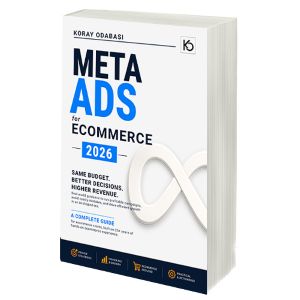
Meta Ads can drive exceptional growth, but only when campaigns, creatives, and audiences work together. This book shows you how to build a scalable Meta Ads strategy using proven ecommerce tactics, practical frameworks, and real-world examples. Learn how to increase conversions, scale winning campaigns, and maximize long-term profitability.
Meta Ads for Ecommerce is a Part of The Ecommerce Growth System
The Ecommerce Growth System is a continuously updated resource built on real ecommerce execution across SEO, Google Ads and Meta Ads. Insights you can apply directly to your business.